
ISRAEL WAS NEVER DESTINED TO BE ESTABLISHED IN ALBANIA
A Rebuttal to Ben Blushi’s Position: History, National Sovereignty, and Albanian Interests
By Flamur Buçpapaj – Writer and Journalist
1. A Historical Debate That Requires Facts, Not Fear
Ben Blushi’s statements concerning the idea of establishing the State of Israel in Albania, discussed in his article published on November 8, 2026, raise an issue that deserves to be examined calmly, through historical evidence and a sense of national responsibility. According to Blushi, Leo Elton, a British journalist of Jewish origin, proposed in 1935 that a Jewish state be established in Albania. Blushi uses this episode to advance the hypothesis that, had the proposal been implemented, Albania might today be facing territorial divisions and conflicts similar to those in the Middle East.
I, Flamur Buçpapaj, reject the interpretation that turns an unrealized historical proposal into a scenario designed to generate fear about Albania’s future. An idea discussed in the past is not the same as an officially approved state plan, an international agreement, or a decision imposed on the Albanian people.
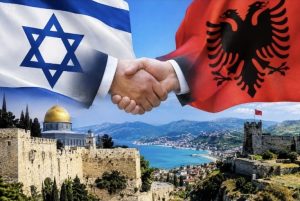
If Leo Elton’s proposal existed in the form described, it should be examined through historical documents, diplomatic correspondence, and archival sources. It must not be used as evidence that the Jewish people had a collective project to take over Albania. Such a claim requires concrete evidence and cannot be attributed to an entire people on the basis of one individual’s actions.
2. Jerusalem and the Ancient History of the Jewish People
The first point of my argument concerns the historical and religious connection of the Jewish people to the Land of Israel and Jerusalem.
Jerusalem occupies a central place in Jewish tradition. According to biblical accounts, King David made the city the center of his kingdom, while King Solomon is associated with the construction of the First Temple. These events form part of Jewish historical and religious memory, although the details of early history continue to be examined and debated by scholars.
An important distinction must therefore be made: Sinai is not where the State of Israel was founded in the historical sense of an ancient state. In biblical tradition, Mount Sinai is associated with the Israelites’ departure from Egypt and the receiving of the Law, whereas the ancient kingdoms of Israel and Judah developed in the Land of Israel.
Likewise, modern Israel was not founded by Solomon. The modern State of Israel was proclaimed on May 14, 1948, by David Ben-Gurion, following decades of political developments, the Zionist movement, the British Mandate in Palestine, and the United Nations’ 1947 partition resolution.
These historical facts are documented by institutions such as the National Library of Israel and the United States Holocaust Memorial Museum.
Here lies one of my central objections to the way this debate is being conducted: history cannot be replaced by hypothetical scenarios. The Jewish people’s historical and religious ties to the Land of Israel are a reality, whereas the idea of establishing a Jewish state in Albania was, according to the account being discussed, an alternative proposal that was never implemented.
3. Who Established the Modern State of Israel?
The modern State of Israel was not established by a single individual, nor was it created solely through a religious decision. It emerged from the interaction of a national movement, Jewish immigration, political organization, international developments, and the war that followed the declaration of independence.
Theodor Herzl was one of the founding figures of modern political Zionism. The First Zionist Congress, held in Basel in 1897, called for the establishment of a publicly and internationally recognized homeland for the Jewish people in the Land of Israel.
The Balfour Declaration of 1917 and the subsequent British Mandate for Palestine influenced later developments. On November 29, 1947, the United Nations General Assembly adopted a resolution calling for the partition of Mandatory Palestine into a Jewish state and an Arab state. Subsequently, on May 14, 1948, the State of Israel was proclaimed.
This history should neither be idealized nor demonized. It includes the persecution of the Jewish people, the Holocaust, and the need of many survivors for security, but it also includes the displacement of Palestinians, wars, and unresolved conflicts that continue to affect the region.
Recognizing the history of a people does not mean endorsing every policy of its government. Likewise, criticizing the actions of a government does not give anyone the right to blame an entire nation, religion, or ethnic group.
4. Albania Is Not Palestine, Nor Is It a Territory Without a National Identity
Albania has its own history, identity, language, culture, and institutions. It cannot be treated as an empty geographical space in which an international project can be imposed without the consent of the Albanian people.
During the 1930s, Albania was a sovereign state with its own institutions and political challenges. Any project involving the settlement of millions of people and the creation of a new political entity within Albanian territory would have required extraordinary political, legal, demographic, and international consideration.
It cannot simply be assumed that a single proposal could automatically have changed Albania’s borders and sovereignty.
For this reason, I do not accept as a sufficient argument the assertion that, had the proposal been implemented, Albanians would inevitably have found themselves in the same situation as Palestinians. This is a hypothetical scenario, not an established historical fact.
Furthermore, comparisons between Albania and Palestine must be made carefully. The history of the Israeli-Palestinian conflict is tied to specific developments, competing national claims, the end of the British Mandate, wars, the refugee question, and unresolved disputes over territory and sovereignty. These circumstances cannot be mechanically transferred to Albanian history.
5. Albania and the Jews: A History of Rescue That Must Be Honored
Albanian-Jewish relations have an important chapter dating back to World War II. Albania became a refuge for Jews seeking to escape Nazi persecution. Albanian families, both Muslim and Christian, sheltered and protected Jewish people, often putting their own lives at risk.
According to information published by Albania’s Ministry for Europe and Foreign Affairs, the country sheltered not only Jews who already lived within its borders but also more than 2,000 Jews who arrived from other countries. By the end of the war, the Jewish population in Albania was larger than it had been before the conflict.
This is a historical achievement that gives Albania dignity and honor. It demonstrates that coexistence, hospitality, and the protection of human life can transcend religious and ethnic differences.
However, this chapter of history should not be used to claim that Albanians are politically indebted to Israel or that they must endorse every decision made by the Israeli government. Historical gratitude and modern diplomacy are two separate matters. Albania can honor the rescue of Jews while simultaneously defending its own national interests.
6. Relations with Israel Must Be Based on the National Interest
I support the development of good relations between Albania and Israel, but these relations must be based on equality, transparency, and the interests of Albanian citizens.
Albania recognized the State of Israel on April 16, 1949, while diplomatic relations between the two countries were established on August 19, 1991. This history demonstrates that our relationship is not a matter born out of today’s political debates, but an established component of Albanian foreign policy.
There are several important areas in which Albania can benefit from cooperation with Israel:
– Technology and innovation: Exchange of expertise in information technology, digital transformation, and cybersecurity, in accordance with the law and data protection standards.
– Agriculture and water management: Modern irrigation technologies, water conservation, advanced greenhouse systems, and improved agricultural productivity.
– Tourism and culture: Promoting Albania as a tourist destination, developing cultural tourism, and expanding university and academic exchanges.
– Defense and security: Cooperation in training, civil protection, disaster response, and defensive technologies, consistent with Albania’s NATO obligations and international law.
– Trade and investment: Concrete projects that create jobs, increase Albanian exports, and bring technology and expertise into the country.
However, every investment must be subject to transparent procedures, fair competition, conflict-of-interest safeguards, and compliance with Albanian law.
Albania must not grant privileges simply because of an investor’s national or ethnic origin. It must negotiate agreements that serve the economy and the public interest.
7. Kosovo and the Importance of Albanian Diplomacy
An important element of Albanian-Israeli relations is Israel’s recognition of Kosovo on February 1, 2021. This development carries considerable diplomatic significance for Kosovo and for Albanian interests in consolidating Kosovo’s international standing.
Albania should appreciate this step, maintain its relations with Israel, and pursue economic and political cooperation. However, diplomacy cannot be built on the assumption that one country must be a permanent friend in every matter or that another must become a permanent enemy.
The national interest requires stable relations with the United States, the European Union, Israel, Kosovo, Arab countries, and other regional partners.
Albania is a NATO member and aspires to European Union membership. These strategic orientations must remain the foundation of its foreign policy.
8. Albania Must Not Become an Arena for Iranian Propaganda or the Propaganda of Any Other Foreign Power
Albania must reject imported propaganda campaigns that seek to turn Albanian society against another people or state through fear, disinformation, or conspiracy theories.
This applies to Iranian propaganda directed against Israel, but equally to any other propaganda seeking to dictate Albanian political attitudes and decisions.
Nevertheless, rejecting propaganda must not prevent us from critically examining the concrete actions of governments. Albania should support international law, the protection of civilians, the release of hostages, humanitarian assistance, and political solutions that ensure security and dignity for both Israelis and Palestinians.
It is not in Albania’s national interest to import the hatred of the Middle East. Equally damaging would be turning a blind eye to civilian suffering or documented violations, regardless of who commits them.
9. An Albanian Foreign Policy Based on Principles
I propose that Albania’s policy toward Israel and the Middle East should rest on five fundamental principles:
First, national sovereignty. No foreign project can take precedence over the constitutional and democratic will of the Albanian people.
Second, interest-based diplomacy. Relations must produce measurable benefits for the Albanian economy, security, education, agriculture, and technological development.
Third, opposition to antisemitism and every form of ethnic or religious hatred. No people should be collectively blamed for the decisions of a government.
Fourth, respect for international law. Albania must uphold the principles of sovereignty, human rights, civilian protection, and the peaceful resolution of disputes.
Fifth, transparency. Agreements concerning investment, security, technology, and trade must be transparent, accountable, and beneficial to the public.
These principles make Albania stronger, not weaker. They allow us to cooperate without submitting, criticize without hating, and defend our national interests without becoming instruments of other people’s agendas.
10. Conclusion: History Must Not Be Turned into an Instrument of Fear
The claim that Israel could have been established in Albania is a historical issue that may be studied, but it must not be transformed into an argument for frightening citizens or creating imaginary enemies.
The Jewish people have an ancient historical and religious connection to the Land of Israel and Jerusalem. The modern State of Israel was established in 1948 through a documented political and international process. Albania, on the other hand, has its own identity and sovereignty, as well as a distinguished history of rescuing Jews during the Holocaust.
Therefore, I see no reason why Albanians should turn this history into fear of another people. We must be capable of distinguishing historical facts from hypotheses, political criticism from hatred, and diplomatic cooperation from submission.
As a writer and journalist, I, Flamur Buçpapaj, stand for an Albania guided not by conspiracy theories, but by knowledge, sovereignty, diplomacy, and national interest.
We must benefit from the technology, economic development, education, and security expertise of our partners, including Israel, while maintaining good relations with all our other international partners.
Albania does not need to embrace hatred in order to defend its identity. It needs a strong state, wise diplomacy, a competitive economy, and citizens who judge matters on the basis of facts. This is the kind of patriotism that truly serves the homeland.