AMERICAN DIPLOMACY AND THE BEGINNING OF THE DEMOCRATIC TRANSITION IN ALBANIA
Written by Flamur Bucpapaj
The late 1980s and the early 1990s represent one of the most decisive periods in the modern history of Albania. After more than four decades of political, ideological, and diplomatic isolation under the communist regime, the country began to experience a profound process of transformation linked to the major changes taking place throughout Eastern Europe. The fall of communist systems in the countries of the former socialist bloc and political changes in Central and Eastern Europe created a new historical atmosphere, which directly influenced political and social developments in Albania.
In this new historical climate, Albanian society began seeking the opening of the country, political pluralism, respect for fundamental freedoms, and integration into the Western democratic world. A deep economic crisis, international isolation, and lack of structural reforms had created a severe social and political situation. Under these circumstances, the pressure for change grew stronger and stronger, gradually leading to the collapse of the communist system and the beginning of the democratic transition.
One of the most important elements of this period was the restoration of Albania’s diplomatic relations with Western countries, particularly with the United States of America. Relations between Albania and the U.S. had been severed since 1946, and for decades the country remained almost completely isolated from the Western world. At the beginning of the 1990s, the restoration of these relations was seen as a strategic step toward international integration and the building of a democratic political system.
In this historical context, American diplomacy began to play an important role in monitoring and supporting democratic developments in Albania. A central figure in this diplomacy was American Ambassador
William Edwin Ryerson, who was appointed to Albania at a time when the country was undergoing deep political and social transformations. His diplomatic activity was not limited to relations with state institutions or the political leaders of the time. On the contrary, he engaged in broad dialogue with representatives of civil society, journalists, researchers, writers, and intellectuals who represented public opinion and the democratic aspirations of Albanian society.
Within this framework, American diplomats carried out a series of visits to various cities across the country to gain a firsthand understanding of the Albanian reality and to monitor political and social developments outside the capital. Special attention was paid to cities with strong cultural and intellectual traditions, which had historically played an important role in shaping Albanian political and cultural thought.
Among these cities, Shkodër held a particularly important place, having been for centuries one of the most significant centers of culture, education, and intellectual life in Albania. Shkodër was known for its rich cultural traditions, its long urban history, and its contribution to the development of literature, journalism, and political thought in Albania.
Even during the communist period, despite strict ideological control and numerous restrictions on cultural and social life, Shkodër managed to preserve an important part of its cultural and historical identity. In the late 1980s and early 1990s, this city became one of the most active centers of democratic movements in Albania.
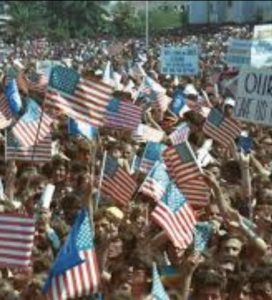
The demonstrations and protests that took place in the city openly expressed demands for political change, pluralism, religious freedom, and respect for fundamental human rights. These civic movements had great symbolic and political importance, as they showed that Albanian society was openly seeking a new path toward democratic development.
At the same time, Shkodër also witnessed an important process of revival in cultural and religious life. After decades of prohibition of religious practices, religious institutions began to reopen and resume their activities. This period also marked a revival of public debate, cultural life, and intellectual activity.
In this atmosphere of profound political and social changes, international diplomacy closely followed developments in Albania. Meetings between foreign diplomats and representatives of the Albanian intellectual elite became an important element of the dialogue that accompanied the beginning of the democratic transition.
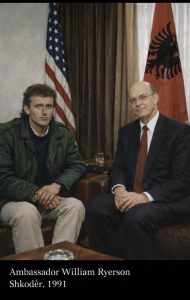
One such moment is documented in a photograph taken in 1991 in the city of Shkodër, showing the Albanian writer and publicist
Flamur Bucpapaj during a meeting with American Ambassador Ryerson. Meetings like these were particularly significant because they provided an opportunity for direct dialogue between international diplomacy and representatives of the Albanian intellectual community.
Through these contacts, American diplomats sought to better understand the Albanian reality, the challenges of the transition, and society’s aspirations for democracy, freedom, and integration into Euro-Atlantic structures. At the same time, for Albanian intellectuals, these meetings symbolized the opening of the country and the resumption of dialogue with the Western world after decades of isolation.
The presence of the flags of Albania and the United States at such meetings was not only protocolary but also carried deep symbolic meaning. It represented the beginning of a new era in Albania’s international relations and its orientation toward democratic values and Western institutions.
This historical period represents one of the most important moments of political and social transformation in Albania. The end of communist isolation and the beginning of the democratic transition paved the way for profound changes in the country’s political, economic, and cultural structures.
Documents, testimonies, and photographs from this period are today important sources for the study of Albania’s transition history. They bear witness to the complex processes accompanying the shift from a totalitarian system to a pluralistic and democratic society, as well as the role played by international diplomacy and dialogue with the intellectual elite in this historical process.