FREEDOM IS AN ILLUSION: PASSPORTS, SURVEILLANCE, AND THE NEW DICTATORSHIPS OF CAPITALISM
The European Union, Airports, and the Invisible Borders of Modern Slavery
By Flamur Buçpapaj
Freedom is an illusion. We live under different forms of dictatorship, which have changed their appearance but not their fundamental nature. Human society has passed through several historical systems: slavery, feudalism, communism, and now capitalism. But are we truly freer today? Have we achieved freedom, equality, and human dignity, or have we simply moved from one form of slavery to another?
Today, we are told that we live in democracies, that we enjoy political freedom, economic freedom, and freedom of movement. Yet reality tells a very different story. All it takes is a journey across Europe, a passage through an airport, the presentation of a passport, and an encounter with endless security checks to understand that freedom of movement is often a conditional right. The passport, which should be nothing more than a document of identification rather than an instrument of division, has become a factor determining who may travel, who must wait, who is subjected to scrutiny, and who is treated with suspicion.
## Passports, Airports, and the Slavery of Movement
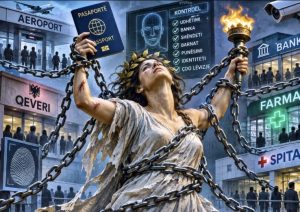
Freedom of movement should be a fundamental human right, not a privilege determined by citizenship, wealth, or the country in which a person was born.
At European airports and seaports, travelers face constant checks, procedures, questioning, waiting periods, and treatment that does not always respect human dignity. In some cases, Albanian travelers encounter prejudice, discrimination, racism, and humiliating treatment. An impression is often created that some citizens are more equal than others.
Why should a person feel suspected simply because they carry a particular passport?
Why must freedom of movement be accompanied by fear, inspections, and uncertainty?
The European Union, which promotes freedom, democracy, and human rights, must also confront its own contradictions. A Europe of airports, seaports, fortified borders, and systems of surveillance cannot claim that every citizen enjoys freedom on equal terms.
## The European Union: A Space of Freedom or a Modern Enclosure?
The journey toward European Union membership is a difficult process. But we must ask ourselves: Is European integration a guarantee of freedom, or merely a transformation of the system of control?
Being part of a major institution is not enough to make someone free. Having a European passport is not enough to guarantee economic security, employment, housing, and food. Across many European countries, there are poor people, unemployed citizens, homeless individuals, and families struggling to make ends meet.
Inequality is everywhere. Everywhere, people struggle to survive. Everywhere, there are police checks, arrests, and procedures that can become instruments of pressure against ordinary citizens.
In Italy, the United States, and former communist countries alike, capitalism has failed to eliminate poverty. It has created extraordinary wealth for some, but it has not guaranteed prosperity for everyone.
I did not see happy populations everywhere. I also saw poverty, insecurity, and people struggling every day simply to make a living.
## Capitalism and the Power of Economic Elites
Modern capitalism is a system in which a significant share of economic power is concentrated in the hands of financial elites, monopolies, and major corporations.
Banks, energy companies, fuel markets, pharmaceutical companies, and supermarkets exert enormous influence over people’s daily lives. High prices, a lack of genuine competition, and the concentration of wealth create a reality in which people work harder and harder, yet often achieve less and less.
Can a citizen who has no job, no home, and no means of providing food for their family truly be considered free?
Can a person be called free when they are forced to work merely to pay the bank, rent, electricity bills, fuel, medicine, and groceries?
This is a form of economic dependence that must be examined seriously. Slavery in the past had visible chains. Modern slavery may take the form of financial chains, debt, dependence on the market, and constant insecurity.
## Antagonistic Classes and the Struggle for Power
Society remains divided into social layers and classes with opposing interests. One group struggles to preserve its economic and political power, while the other fights to survive within a system that does not guarantee equal opportunities.
The poor often pay the highest price. People are sent to war, killed, arrested, abused, and forced to bear the consequences of decisions made by political and economic elites.
In many cases, wars, conflicts, and crises serve the interests of monopolies, banks, the arms industry, and powerful economic groups. Political power itself can become a mechanism for protecting the interests of a narrow circle of individuals.
In some countries, those in power refuse to relinquish their positions. They establish systems of patronage, control institutions, and use public wealth to strengthen their own positions.
Corruption and unlawful enrichment are among the most serious forms of plunder inflicted upon society.
## Constant Surveillance: The State, Banks, and the Market
Today, people are monitored at every step. They are monitored by the state, banks, corporations, electronic systems, cameras, financial institutions, and the mechanisms of the market.
They are monitored when they travel, when they work, when they take out loans, when they purchase fuel, when they visit pharmacies, and when they enter supermarkets.
Even the food we consume raises serious questions about the use of pesticides and various chemical substances. Pollution, the depletion of natural resources, and environmental degradation are threats that directly affect human life.
We live under constant surveillance, while ordinary citizens often lack both the transparency and the power needed to hold those exercising authority accountable.
This is one of the great contradictions of modern society: citizens are increasingly monitored, yet those who hold economic and political power do not always answer for their actions.
## The Crisis of the Family and the Future of Humanity
Another major problem is the exhaustion of society’s resources, population ageing, and declining birth rates. In many countries, people are becoming increasingly reluctant to establish families and bring children into the world.
Why?
Because they lack economic security, they have no housing, they lack stable employment, and they cannot see a secure future.
It is heartbreaking when a couple must think twice before bringing a child into the world, not because they do not want a family, but because the system fails to guarantee the minimum conditions necessary to raise one.
The traditional family faces numerous economic and social pressures. Separation, insecurity, and financial hardship are part of a broader crisis that demands serious analysis rather than mere accusations or moral judgments.
A society that cannot guarantee the future of its children is a society that must ask itself where it is heading.
## Where Is the Revolution?
Where is the revolution against poverty, corruption, monopolies, and unlimited power?
Where is the revolution against those who use the state for personal enrichment?
Where is the revolution against social injustice, unemployment, homelessness, and the destruction of human dignity?
Perhaps the revolution will come. But above all, it must be a profound political, economic, and social transformation. It must be a powerful movement against political classes that refuse to be held accountable, against corruption, against monopolies, and against every form of domination that treats human beings as instruments serving the interests of others.
This transformation must be determined, courageous, and uncompromising in its opposition to injustice. However, it must be built through civic organization, peaceful protest, democracy, and institutional change, not through violence against people.
Freedom cannot be built by creating another dictatorship.
## Freedom Is Not a Document, but a Human Right
Freedom is not a passport. Freedom is not a stamp at an airport. Freedom is not an electoral promise or a political propaganda slogan.
Freedom is the ability to live without fear, to work with dignity, and to have access to housing, food, education, and healthcare. It is the right to travel without humiliation, to express one’s opinions without intimidation, and to live without being held hostage by monopolies, banks, or those in power.
Neither capitalism nor communism, nor any other system, should be considered sacred or beyond criticism. Every social order must be judged by how it treats human beings and by the real opportunities it provides to its citizens.
We must demand a society in which wealth is not concentrated in the hands of a few, where institutions are accountable to citizens, where justice is equal for everyone, and where no one is humiliated because of the passport they carry.
**Freedom is an illusion as long as human beings do not have the genuine ability to choose their own lives.**
And the question we must ask ourselves is simple:
If we are not free to travel without being treated as suspects, if we are not free to live without poverty, and if we are not free to secure a future for our children, then what kind of freedom have we actually achieved?
Perhaps we have changed systems, changed flags, changed institutions, and changed the names of those in power, but human beings remain subjected to forces they cannot control.
**True freedom remains an unfinished battle of humanity.**
**By Flamur Buçpapaj – Writer, Publicist, and Journalist.**