
Language as Identity and Power: An In-Depth Reading of the Ohrid Framework Agreement and Its Political Challenges
Flamur Buçpapaj
In the modern history of North Macedonia, the Ohrid Framework Agreement is not merely a political document born out of the need to end a conflict; it is a foundational moment that reshaped the relationship between the state and its citizens, placing language at the center of equality, identity, and democratic functioning. At its core lies an idea long denied: language is not only a means of communication, but a dimension of collective existence, an expression of dignity, and a right that cannot be reduced to a temporary political compromise without consequences.
This agreement created a new legal and political architecture in which the state acknowledges its multiethnic character and builds mechanisms to ensure the inclusion of communities in public life. The principle of the 20% threshold, which grants official status to any language spoken by a significant portion of the population, became a balancing instrument between unity and diversity. It institutionalized the Albanian language and elevated it to a new level, while simultaneously creating a model in which rights are tied to numerical weight, leaving open the debate as to whether equality should be absolute or conditional.
At the institutional level, the right to use one’s mother tongue in parliament, administration, and communication with the state represents a major step toward a functional democracy. Yet experience has shown a clear gap between the law and its implementation. Bureaucratic procedures, lack of capacity, and political tensions often weaken this right in practice, turning it into a standard that is not always applied equally.
The transformation of public space through bilingualism at the local level is one of the most visible outcomes of this agreement. It reflects a new reality in which the presence of language is also the presence of identity. However, even this achievement remains fragile in the face of political perceptions and differing interpretations that continue to accompany the language issue.
In the sphere of education and culture, the agreement aims to build a more sustainable future by guaranteeing the development of linguistic identity. Yet the challenge lies in finding a balance between preserving identity and building an integrated society, where multilingualism does not turn into structural division.
In this context, a fundamental question arises: what happens if the spirit or provisions of the Ohrid Framework Agreement are not respected or are weakened? For Albanians in North Macedonia, this is not merely a technical or legal issue; it is directly about equality and their position within the state. In such a situation, the response would likely begin on an institutional and political level: increased pressure through parliamentary representatives, possible boycotts of institutions, civic mobilization, and calls for international intervention.
Albanian political parties, whether in government or opposition, would face a serious test of their legitimacy. Those in power would have to demonstrate whether they are capable of defending the rights they claim to represent or whether they are constrained by coalition compromises. The opposition, on the other hand, would seek to capitalize politically on the situation, presenting itself as a stronger defender of national interests. This dynamic could lead to further political polarization within the Albanian political spectrum itself.
Meanwhile, Macedonian political parties, both in power and in opposition, would face pressure to maintain a balance between state stability and demands for centralization or reinterpretation of the agreement. Any move perceived as a step backward could increase interethnic tensions and undermine the stability achieved with difficulty.
In this situation, the role of Albania becomes both important and delicate. As a kin-state and regional factor, Albania would likely act on several levels simultaneously. First, on the diplomatic level, it would seek full respect for the rights of Albanians in accordance with international agreements and European standards, using official channels with North Macedonia and international partners. Second, it would intensify communication with Euro-Atlantic actors, framing the issue as part of regional stability and the European integration process.
Politically, Albania would try to maintain a balance between supporting the rights of Albanians and avoiding escalation of tensions. It has no interest in destabilization, but rather in a sustainable solution that strengthens coexistence and regional stability. At the same time, it may play a mediating role by encouraging dialogue between the parties and promoting respect for the spirit of the Ohrid Framework Agreement.
At the public and national level, Albania would be under internal pressure to react more strongly, as Albanian public opinion views the issue of language and rights as part of national identity. This could push toward stronger political statements, but without crossing into actions that would endanger regional stability.
If the situation escalates, there is a risk that the language issue could shift from a legal matter to one of security and stability. However, the current reality and the Euro-Atlantic aspirations of North Macedonia create a framework that favors political solutions and dialogue rather than conflict.
In the end, the way language is treated remains a direct indicator of the quality of democracy. A state that respects the languages of its citizens builds trust; a state that relativizes them risks producing insecurity and division. The Ohrid Framework Agreement opened the path toward equality, but its preservation and deepening depend on political will and on society’s ability to see diversity as a strength rather than a threat. Because in the end, language is not only how we speak—it is how we exist and how we seek
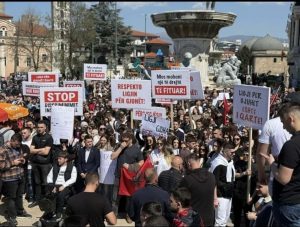
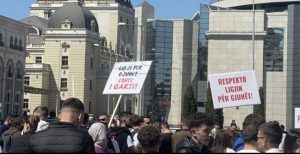
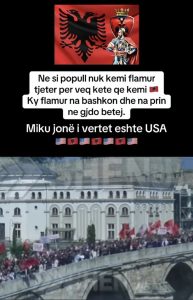
Not only official Albania, but also many Albanians beyond institutional structures are deeply outraged by what is perceived as dismissive and discriminatory behavior toward Albanians. From a national perspective, the message is clear: this issue must be addressed and resolved swiftly, before it is too late.
Language as Identity and Power: An In-Depth Reading of the Ohrid Framework Agreement and Its Political Challenges Flamur Buçpapaj
- Radio Nacional

“Nuset e Vilës Blu” – Roman nga Flamur Buçpapaj
Romani i ri i autorit Flamur Buçpapaj, botuar nga Nacional, sjell një udhëtim mes dashurisë, dhimbjes dhe kujtesës – aty ku e kaluara dhe e tashmja takohen në një vilë blu plot sekrete. Gjej librin në libraritë kryesore dhe mëso pse “Vila Blu” nuk është thjesht një vend… por një simbol i shpirtit shqiptar. Për porosi ose kontakt: 067 533 2700