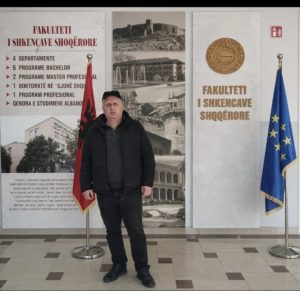
EDITORIAL – March 7 and the Crisis of Albanian Education
By Flamur Bucpapaj
March 7, the Day of the Teacher and the Albanian School, is one of the most important dates in the national history of Albania. It is connected with the opening of the first Albanian-language school in Korça in 1887, a moment that symbolizes the birth of national education and the effort of Albanians for knowledge, culture, and their national identity. For many years this day has been celebrated with respect and gratitude for the teacher, a figure who in Albanian tradition has always been considered a second parent.
However, today, when this symbolic day arrives, the reality of Albanian education is far more complex and often worrying.
One of the greatest problems is the emptying of schools, especially in the north of the country and in mountainous areas. Villages that once had classrooms full of students are now almost deserted. Massive depopulation, emigration abroad, and internal migration toward the western lowlands have caused many schools to close. In many remote areas, children are forced to walk for hours to reach school because the school in their village has been closed due to the lack of students.
This phenomenon is not only an educational issue; it is a demographic and social drama that is changing the structure of the country. When a school in a village closes, in reality the hope for the future of that community also closes.
Another pillar of the crisis in education is the low quality of teaching. In many schools there is a lack of laboratories, modern didactic equipment, functional libraries, and even sports facilities. Students often learn only in a theoretical way, without opportunities for experimentation or practical learning. Under such conditions, it is difficult to create a modern education system that can compete with European standards.
Even the system of compulsory nine-year education, although established by law to guarantee basic education for every child, in practice has often turned into a formality. Many students move from one grade to another without mastering the basic skills of reading, writing, and mathematics. This creates an entire generation with educational gaps that later reflect in secondary education and in professional life.
Another important problem is the way teachers are employed. In many cases the employment process has become politicized and influenced by the interests of political parties or patronage networks. This damages meritocracy and the quality of the education system. When a teacher is employed not because of merit but because of political connections, the system begins to weaken from within.
At the same time, the teaching profession is increasingly undervalued both economically and socially. Salaries often do not correspond to the responsibility and importance that this profession has for society. Teachers face social pressure every day, problems of discipline in classrooms, and a lack of institutional support.
Recent public debates regarding cases of violence in schools have created a climate of tension between society and teachers. Certainly, any form of violence against children is unacceptable and must be addressed according to the law. However, it cannot be accepted that because of a few isolated cases the figure of the Albanian teacher is publicly denigrated. Entire generations have been educated by dedicated teachers who worked with sacrifice in conditions far more difficult than today.
In Albanian tradition, the teacher has always been a moral and social authority. In many areas of the country the teacher was not only an educator but also a community advisor and a model of citizenship.
Therefore, the reform of education must be based on several strong and long-term pillars.
First, meritocracy must be restored in the education system. The employment and promotion of teachers must be based only on professional ability, academic preparation, and pedagogical experience, without political interference.
Second, it is necessary to increase investments in educational infrastructure. Scientific laboratories, modern libraries, digital equipment, and sports facilities are not luxuries but fundamental elements of quality education.
Third, the state must develop serious policies to protect schools in rural areas and to support families living in these regions. Without a development policy for villages and mountainous areas, schools will continue to close.
Fourth, the economic and social dignity of teachers must be strengthened. A respected and motivated teacher is the foundation of a healthy educational system.
Finally, education must be freed from bureaucracy and formalism. Schools must become places where knowledgeable, critical, and responsible citizens are formed, not simply institutions where students pass grades without truly learning.
March 7 should not be only a ceremonial day. It should be a moment of reflection about the future of Albanian education. Because a nation that does not seriously invest in education risks losing not only knowledge, but also its own future.